
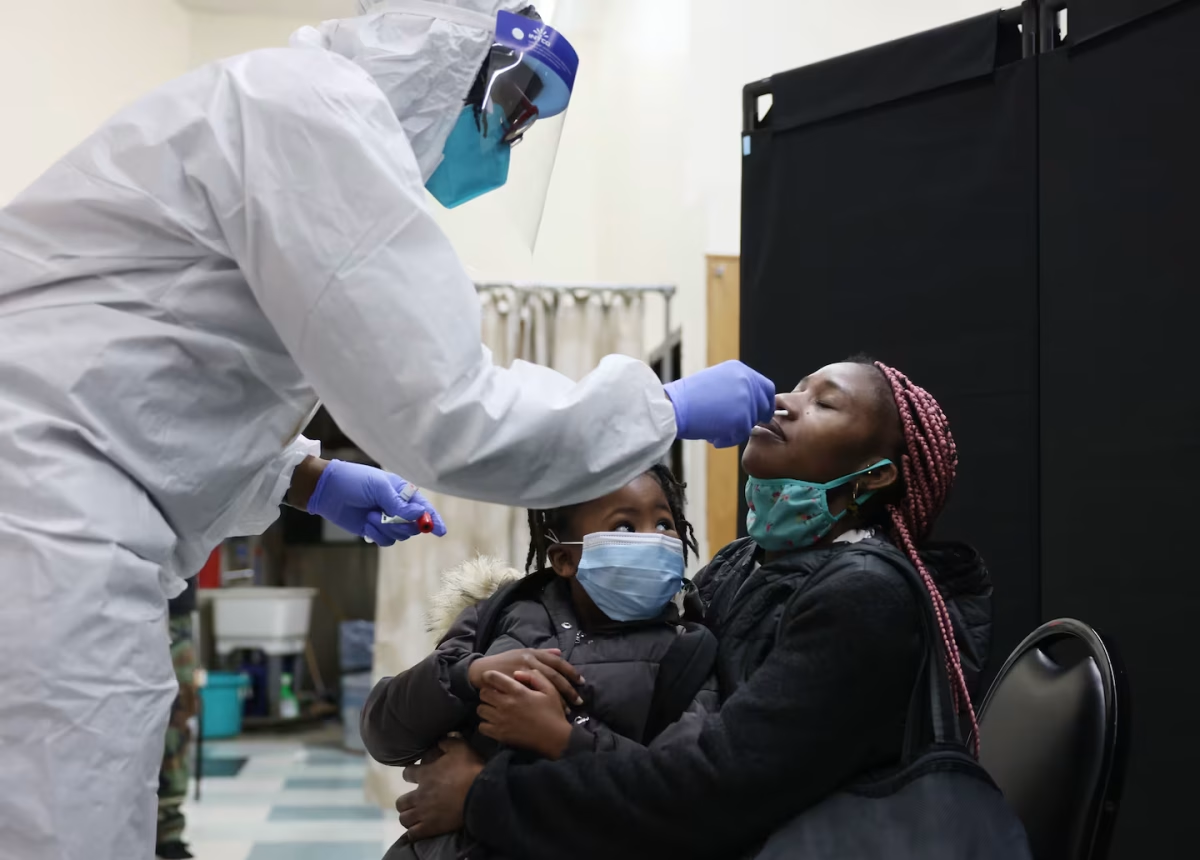
For most of America, on March 11, 2020, COVID became real. On that day, The World Health Organization declared the novel coronavirus an official “pandemic.” Two days later, then President Donald Trump declared a national emergency, but it had already infected thousands and case levels were rising dramatically.
Images are seared into the American psyche of a masked population at home, work or school; shuttered restaurants, bars and other social venues; frustrated shoppers scrambling for essential items like bread and toilet paper; long lines outside emergency rooms, food pantries and food banks; virtual funeral, church and graduation services and many more heartbreaking photos and memories.
On March 16, 2020, the first confirmed, positive COVID-19 test result in the region was of a young St. Louis County woman who had recently traveled to Italy. In April, St. Louis City reported a total of 565 cases of COVID-19 and 13 deaths while St. Louis County reported 1,337 cases and 28 deaths. By the end of 2020, more than 300,000 people had already succumbed to the disease. To date, more than 1,219,487 Americans have died from the disease.
Dr. Kendra Holmes, president & CEO for Affinia Healthcare, a nonprofit that focuses on primary and preventative healthcare, was alarmed at the pandemic’s very start.
“The first thought I had was, it was going to impact poor Black people more than any other demographic,” Holmes recalled. “Any type of crisis-housing, unemployment-it’s going to impact Blacks more. So, I thought, ‘what are we going to do for Black people?’
“This was the time when the word ‘health equity’ was just a buzzword,” Holmes added. “So, I naively thought we were going to see this major, major focus on the underserved. But from the moment I saw they put up the first testing site in West County, I thought ‘no, we gotta do something.’”
Even with limited resources, Holmes said Affinia went into action setting up testing sites in the city and county.
“We opened our first testing site (in the city) on April 3rd (2020) even though we had extremely limited funding. It was such a period of so many unknowns, we didn’t even know it was airborne at that point. So, we put ourselves at risk because I didn’t trust anyone else to do it and I still don’t.”
Mayor Tishaura O. Jones took office a year after the pandemic’s outbreak. Months into her term, she appointed Dr. Matifadza Hlatshwayo Davis as director of the city’s health department. Dr. Davis remembers her dual feelings of excitement and dread.
“COVID was a year and a half in,” Dr. Davis recalled. “I had two weeks to come up with a roll-out plan for pediatric vaccines around the time when Omicron was announced which was the largest spike during the pandemic. I inherited less than one percent of the city’s budget while trying to meet this moment. Keep in mind, we also live in a state that’s dead last in the country on per capita spending on public health. So, my excitement was quickly tamed by reality. It was a lot.”
The first three to six months were particularly challenging, she confessed.
“I was learning on the job. I never worked in city government. This was a whole different field to navigate. I’m not a politician, I didn’t get an orientation, there was no transition plan waiting for me and I inherited a very tired and despondent staff. Navigating a global pandemic when you’re dealing with basic bureaucratic challenges with a lack of infrastructure was definitely the hardest part.”
The first vaccine doses were administered in mid-December 2020 after the FDA granted emergency use of the Pfizer-BioNTech and the Moderna COVID-19 vaccines. From December 2020 to June 2023, billions of COVID-19 vaccines have been given while researchers continue to study more vaccines that prevent the disease.
“We are now in the post-pandemic era, but it still lives amongst us,” Dr. Davis continued.
“We have classified it as one of the top three respiratory illnesses. When we look at its influence on RSV (respiratory syncytial virus), especially during the winter months, we see more of these respiratory viruses circulating with their own ebbs and flows and we’re still trying to understand COVID’s cadence to deal with it accordingly.”
As far as health outcomes, Dr. Holmes said the country is worse off.
“There are more individuals with long COVID, there are higher incidences of individuals who’ve had strokes after COVID…this on top of the already high rates of diabetes and high blood pressure we already have, is another layer of chronic illnesses Black people now have.
Still, Holmes found a surprising positive from the COVID experience
“What we’ve seen, from a community health standpoint, is that Black people are advocating more for their health and sounding the alarm when they know they’re not receiving the care they deserve. That’s a positive because Black people saw the unfair distribution of resources and we are not willing to allow that to happen again.”
Sylvester Brown Jr. is the Deaconess Foundation Community Advocacy Fellow.